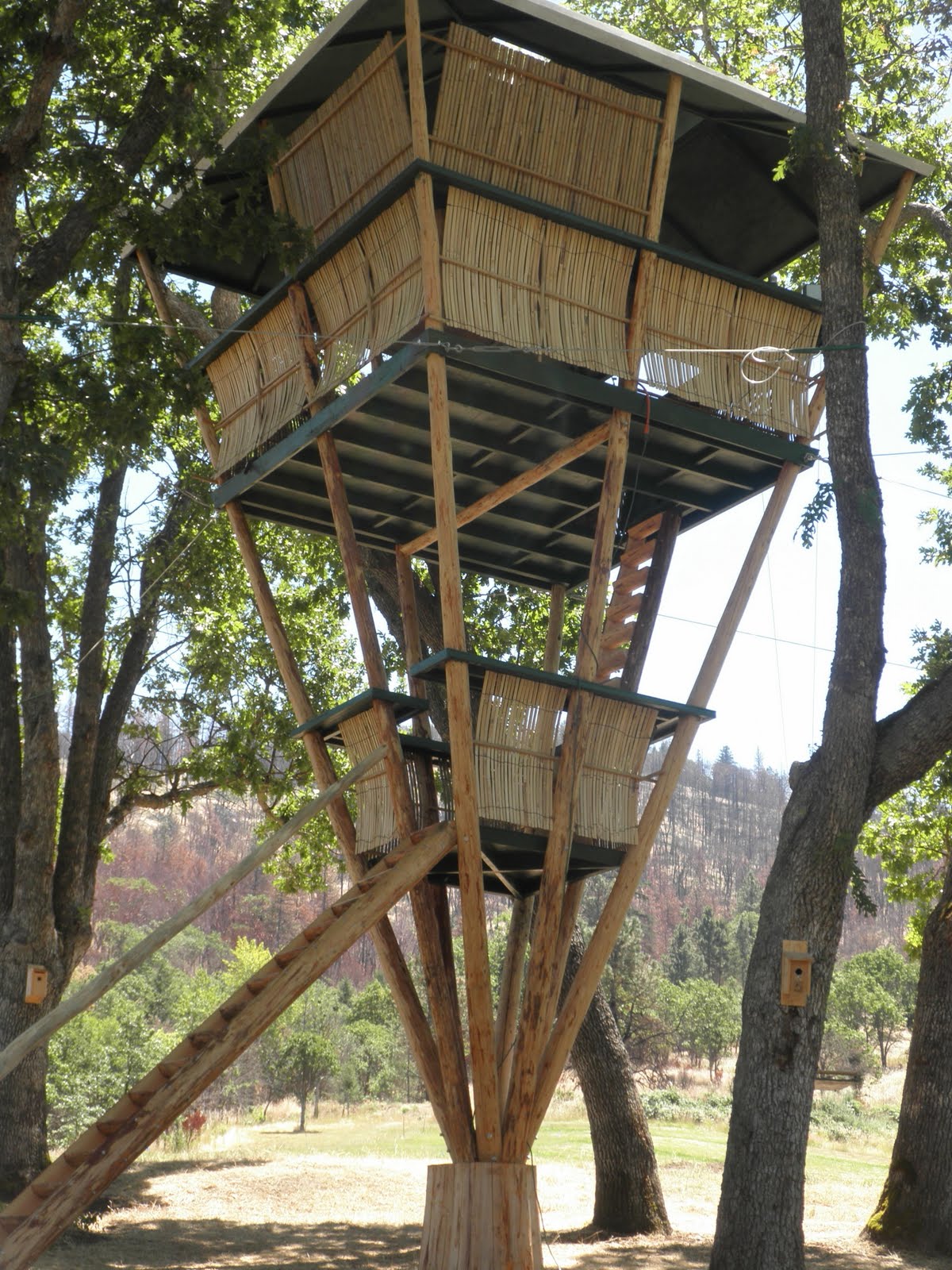
bamboo treehouse

An informal blog version of my formal website. The intention is to add news and some insight into my ongoing predilection for bamboo and the hooch. With these raw materials and conceptual abode, I have evolved a paradigm for living lightly on this Earth. It is quite the adventure, so, why not share.

Monday, November 26, 2007

The Solar Hooch (Tower of Power)


Imagine a treehouse that heats itself, now imagine a treehouse that not only stays warm (most of the time), but also produces more electricity than it uses. That is the concept behind the solar hooch- a backyard "Tower of Power" that can actually contribute to lowering your electrical bills. A well situated urban home should encourage lush vegetation and trees to shelter it from cold winds in the winter, and the hot sun in the summer. Consequently, there is a conspicuous shortage of clear, unobstructed windows of light from which can be collected thermal and photo-voltaic energy from the sun. Enter the backyard solar hooch. Perched on a single point, with cables to surrounding tree, the hooch provides a space for escape without infringing on the backyard space. High in the air, the hooch rises above the shadows cast upon the ground-from trees and buildings. With an unobstructed southern exposure, the solar hooch catches and stores solar heat through an abundance of south facing windows. The sun shines through upon a unique array of water filled aluminum cans that span the loft. With a days worth of solar thermal energy stored in the water, the bamboo mesh futon can be lowered over the storage for a night of warmth and comfort.

The south facing windows are augmented with large photo-voltaic panels that double as shutters that close over the glass and conserve all that valuable heat that was collected. The electricity generated is pumped back into the grid for use later- in the hooch, or in the real house-down below. The hooch becomes more than carbon-neutral- it actually contributes to ameliorating the carbon footprint of the real house.

Power aside, the hooch can serve as very comfortable refuge for the stressed, the weary, the solitude starved urban dweller. Do the Earth a favor, and find yourself in a hooch.
The solar hooch, along with many other concepts (real or imagined) can be seen in all its 3D splendor at: http://sketchup.google.com/3dwarehouse/cldetails?mid=2b0ce1cd638c2c3a818b74cda2c7ac0&prevstart=0


Labels: , , , , ,

Tuesday, May 15, 2007

bamboo cruise control


yet another bamboo innovation- the bamboo cruise control. I was tired of being all bent over, as the conventional mountain bike/ racer biker makes you be. I wanted to sit up for around town cruising. The easy strategy for achieving the raised handle bars was merely to connect the ends of the handle bar ends with a bamboo bar. Voila- bamboo cruise control. I sit up, see the world, and the bamboo cruise control is a good feel. Brakes are still on the conventional handle bar, but the upper bar is useful for most of bicycle cruising. Light weight, natural, bamboo! Perfect!

Labels:

Tuesday, February 20, 2007

a carbon neutral treehouse vacation


I recently read a post about Richard Branson's plan to build a carbon neutral vacation resort on an island in the Caribbean. Another discovery was a carbon credit calculator produced by Linda Garland, president of the Environmental Bamboo Foundation, based in Paia, Maui, and East Bali: http://bamboocentral.org/shareinrepair/steps.htm . The concept is to offset your carbon footprint incurred by your lifestyle by donating to the establishment of a bamboo plantation, and thereby sequester an equal amount of carbon. With your donation, your carbon footprint becomes zero.
Bamboo grows at a phenomenal rate, and is therefore a very efficient and effective method of sequestering carbon from the atmosphere, and counteracting the carbon production our lifestyle incurs. It has been estimated that bamboo sequesters carbon at a rate of 62 tons/hectare/year, as compared to 15 tons/hectare/year for a tree forest. This translates to 25 tons/acre/year and 6 tons/acre/year respectively.
Our Tropical Treehouse property in Rincon', Puerto Rico, has been sequestering carbon, retaining moisture, and preventing erosion since our stewardship of the property began in 1992. Through a concerted effort of rehabiltation of the land with a permaculture strategy, the land has become, not only a paradise of beautiful flora, but an effective carbon sink- way beyond our family's carbon footprint.
A historical perspective. The land, once a forest, was cleared and the rich, fertile land was used to grows sugar cane for the subsistence Puerto Rican farmers up until the early 1950's. A collapse of the sugar cane market led to a migration of many families to the states, and a re-defined utility of the land. It was used for cattle grazing. With an already degraded/eroded soil, the degradation continued. The owner/farmer kept the jungle in check with his machete', and lived to a ripe old age of 92, aided, in part, by a steady supply of rum,beer, and milk of magnesia (the bottles stashed at the base of the old mango trees testified to this lifestyle) Finally, the land went fallow, and became an impenetrable mass of vines and stunted naturally sprouted trees- royal palms, mango, ceiba, and wild sour orange..
That was when the land came into our custody in 1992. It took me 5 years to clear the vines, after my day job as a teacher and lab technician at the local university. Once freed, the trees reached for the sky. Today, those royal palms are tall and majestic. In our efforts to transform the land to a permaculture ideal, we planted over twenty species of bamboo, and hundreds of native Puerto Rican hardwoods. Today, what was once a neglected, stunted land of 20% forest, is a mature, double canopy forest covering close to 85% of the land.
The original intention of planting a bamboo forest was to provide a building material for my architectural projects. To grow your own house has multiple ecological advantages, in addition of maintaining the carbon sequestration of bamboo- by using it.
Today, the Tropical Treehouse is a truly green enterprise. The main house employs solar hot water, rain water collection, and is furnished with bamboo furniture from bamboo grown on the land. The hooch treehouses are self sufficient- 12 volt solar photo-voltaic electricity, solar hot water, and structure built from bamboo that was planted, grown, and harvested on the very land that they stand.
With a bamboo forest covering 3 acres, and the rest of the property in mature forest, a conservative estimate of our carbon sequestration is well over 100 tons/year- far more than the carbon footprint of our family. Consequently, like Richard Branson, we can offer a totally carbon neutral vacation. Airline flight has a relatively heavy carbon footprint, costing .16 tons of carbon/1000 miles travelled. Or, an average of .32 tons for a round trip to Puerto Rico from the states. With our large surplus of carbon sequestration capability, we can offer a carbon offset for airline travel of all our guests, as well as any carbon footprint incurred from driving your rental car.
Our bamboo forest biomass is growing at a rate of 20% per year, thus increasing our rate of carbon sequestration. As a guest in our slice of paradise, you will be contributing to this cause, and will help insure our small contribution in ameliorating the effects of global warming, and saving planet Earth.

Monday, September 04, 2006

The 3D hooch


After some effort, I've managed to render the hooch in 3D. Using Googles' Sketchup software (free), the hooch can now be viewed from any perspective. You can climb the stairs, go inside, peer up through the skylight, hang out. Way cool!
This particular file is 6 MB and you will need to download the Sketchup software. But, hey, its free! The file can be found at: http://sketchup.google.com/3dwarehouse /

Ue "hooch" as the search word

Saturday, August 26, 2006

the venice beach hooch gets a facelift


After three years, we returned to Venice beach to correct a situation of dire circumstances. The original hooch, built with local B. bechyanna bamboo, was being eaten up by bugs. The particular species of bamboo, harvested locally from the estate of Jerry Bruckheimer, was strong, straight, and big. Unfortunately, it also has a very high starch content- food for the bamboo beetle, Dentritis minutis. The bamboo was nothing much more than skin and powder, however still strong and standing. Over a two week period, with much time devoted to beach activities, we replaced the bamboo, pole by pole, with FSC certified Douglas fir poles, harvested in Southern Oregon. The new hooch is pretty as ever, and strong enough for a major party.
My thanks to Sid and Eileen for being such wonderful hosts.

Saturday, May 20, 2006

The Hooch: concept; and the original


The concept: to build an environmentally sensitive treehouse. Make it a universal design, that requires no special engineering or designing that fits only in one particular tree. Make it pre-fab, make it so it can be placed anywhere, with negligible site alteration. Make it small- no building permit, make it temporary - no permanent foundation, and make it light - efficient use of materials. And, of course, make it out of bamboo - renewable, flexible, strong, light, - a natural!

Here is the original hooch (the one below). It is the master bedroom of our home in Rincon', Puerto Rico. The basic structure is made from Guadua bamboo poles. It has withstood category three hurricane winds, and many seasons of falling mangoes.

The trailer/ladder perch (above) is one way cool version of the basic concept: get high, and see forever. I have no idea of the origin of the pic- but it certainly conveys the message- live lightly, with a small footprint (literally, and figuratively)

bamboo bicycle panniers


This is so cool. Bamboo panniers made so that the common grocery bag fits perfectly in each space provided. The whole pannier is easily attached and removed with bungee cords on the standard metal back rack. As you can see, I've can load some major loads. my record is $77 worth- including heavy stuff like a gallon of milk, and beer, of course.
I have launched a program to use my bicycle and bamboo panniers for all our grocery needs. No fossil fuels, and it is great sport. So efficient: loading, unloading, and the actual peddling from home, to store, to home. I live in the small town of Ashland- very bike friendly. I can take the bike path most of the way to our favorite grocery store- and it is mostly downhill for the loaded ride back.
I now employ re-usable canvas grocery bags, instead of the paper bags shown - even more eco-logical. Ultimately, I want to add a front set of bamboo panniers- for a four bagger. Stay tuned....

bamboo treehouse

Okay, I'll try this. I'll blog the latest in my ongoing romance with the hooch (bamboo treehouse), bamboo craft, and whatever else crosses my mind. That's what blogging is all about, right?
In the meantime, until I get this together, you can see my formal site, which is quite comprehensive, about the hooch, my bamboo, and various other bamboo creations:

www.tropical-treehouse.com

The Long Tom River hooch, in Noti, Oregon- just West of Eugene, near the Oregon Country Fair. The hooch is 10' by 10', and uses locally harvested Douglas Fir poles instead of bamboo- as with all the tropical hooches out there.